
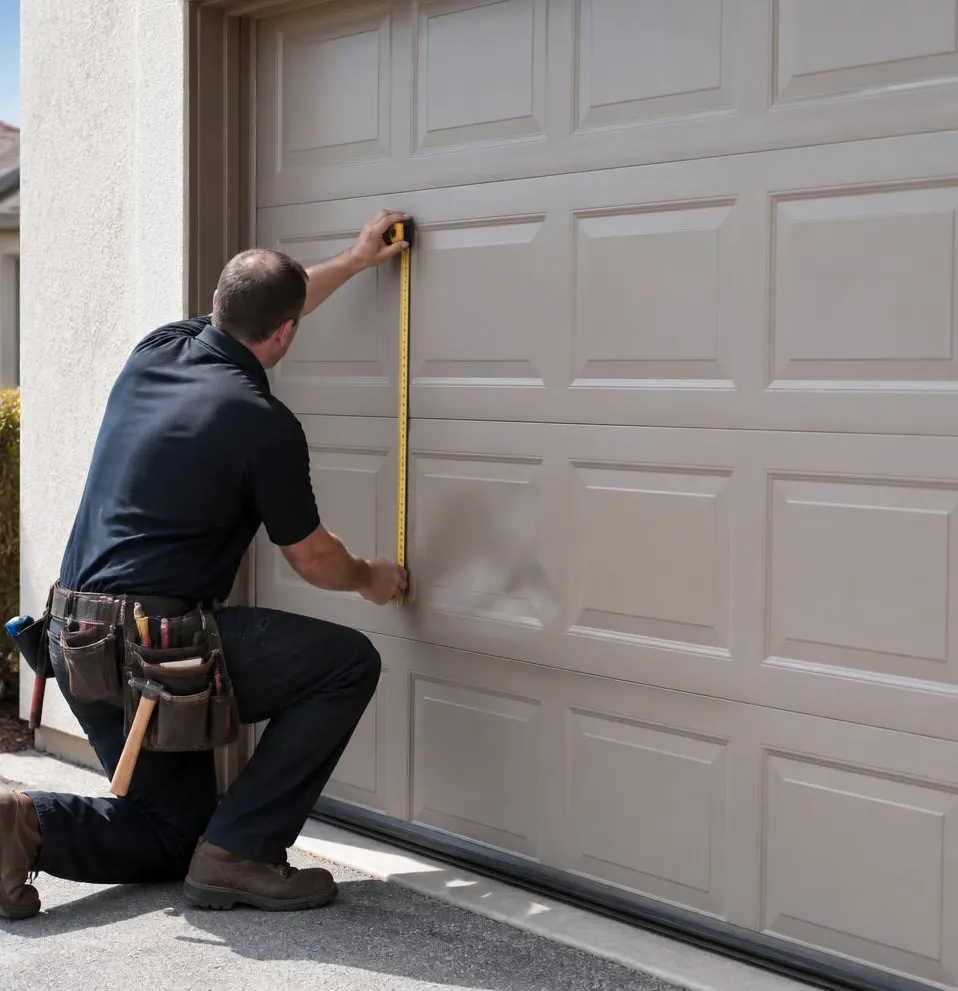
You press the button and the door doesn't glide the way it used to. It hesitates about a third of the way up, there's a grinding or scraping sound you can't place, and when you finally look up at it fully open, one side sits noticeably higher than the other. That's the moment most homeowners first notice a bent or misaligned track, and it rarely fixes itself. In fact, left alone, it tends to get worse fast, putting extra strain on rollers, hinges, and eventually the opener motor.
Symptoms to Watch For
Before getting into causes, here's what a damaged or misaligned track typically looks like in real life:
- The door catches or jerks at a specific point in its travel, usually always the same spot.
- Visible gap between a roller and the track, or a roller that's popped partway out.
- Scraping or grinding noise that wasn't there before, often louder on one side.
- The door looks crooked or tilted when fully open, instead of sitting level.
- The door reverses on its own partway through closing, because binding confuses the safety sensors or force settings.
- One side visibly moves faster than the other during opening or closing.
Any one of these on its own might be minor. Two or more together usually means the track has shifted out of alignment or taken physical damage.
How a Technician Tracks Down the Cause
1. Visual Inspection for Impact Damage
The first thing a technician checks is the obvious: dents, kinks, or bends in the track itself. This is often caused by a vehicle bumper, a ladder, a bike, or lawn equipment bumping into it. Even a small dent changes the track's shape enough that rollers bind as they pass through it. Minor bends can sometimes be carefully straightened with locking pliers or a mallet while the track is still mounted. More significant bends usually mean replacing that section of track rather than risking a repeat failure later.
2. Loose Mounting Brackets and Fasteners
Next comes a check of every bracket holding the track to the wall and header. Years of door operation, plus the vibration from wind gusts pushing against a closed door during a storm, can slowly work lag bolts loose. A track that's still straight but loosely fastened will flex every time the door runs, which eventually bends it anyway. The fix here is straightforward: retighten or replace fasteners, and confirm the wall anchors are still solidly seated in the framing, not just the drywall or siding.
3. Plumb and Alignment Check
With brackets secure, the technician checks whether the vertical tracks are plumb and the horizontal tracks are level and parallel to each other. Minor shifting in the structure over time, or an installation that was never perfectly aligned to begin with, can throw this off. Correcting it means loosening the brackets just enough to reposition the track, checking it with a level, and retightening — a precise job, since even a quarter-inch of misalignment can cause the door to bind.
4. Roller and Hinge Wear
Worn, cracked, or dried-out rollers don't just sound bad, they put uneven pressure on the track every time the door moves. This is especially common after a hot summer, when nylon rollers can degrade faster and lubricant dries out. Replacing worn rollers and hinges, and relubricating moving parts, often resolves binding that looked like a track problem but wasn't entirely one.
5. Track Gap at the Curve
Where the vertical and horizontal sections meet is a common failure point, especially if the door has taken any impact. A gap here shows up as a rough, clunky transition rather than a smooth curve. Fixing it usually involves realigning or replacing the curved section itself.
6. Opener Travel and Force Settings
If the track and rollers check out fine, the last step is checking the opener's travel limits and force settings, since a door fighting a slightly misaligned track will often trip the opener's safety reversal. Adjusting these settings is only appropriate once the mechanical issue is actually resolved, not as a workaround for it.
When to Call Piedmont Garage Door
Track work means working around a door under spring tension, and that's not a place for guesswork. If your door is catching, scraping, or sitting crooked, that's the time to call for garage door repair. We'll inspect the track, rollers, hinges, and springs together, since a problem in one often shows up as a symptom in another. If we find worn rollers or hardware contributing to the issue, we'll flag that as part of routine garage door maintenance so it doesn't turn into a repeat visit. With storm season tapering off but wind and sudden gusts still common across Piedmont, Yukon, Edmond, and the surrounding area, this is also a good time to get the whole system checked before winter weather sets in.
If your garage door in Piedmont, OK is scraping, sticking, or running crooked, give Piedmont Garage Door a call — we'll get it running straight and quiet again.